
Buy Cruelty Free Lashes in Bulk: A Buyer's Guide
Table of Contents
- Why Buying Cruelty Free Lashes in Bulk Pays Off
- False Lash Materials and Fibres: What You're Actually Paying For
- Vegan False Lashes Wholesale: Reading the Labels Properly
- The Wholesale Lash Supplier Checklist Every Buyer Needs
- Building a Professional Makeup Artist Lash Kit
- Bulk Order Quantities, Shipping and Returns
- Storing Bulk Lashes So They Stay Salon-Ready
- Conclusion
- Frequently Asked Questions
Last Updated: October 19, 2026
Why Buying Cruelty Free Lashes in Bulk Pays Off
Buying cruelty free lashes in bulk is the single most effective way to cut your per-set cost without compromising on ethics. At Pretty Lashes, we've watched makeup artists and salon owners quietly shift their whole stock model this way. Instead of buying three or four pairs at retail whenever a client booking lands, they buy a batch and stop worrying about running out mid-season.
The maths is simple. Retail pricing bakes in packaging, handling and the shop's margin. Buy in volume and those costs spread across dozens of sets. You also get consistency: the same curl, the same band flexibility, the same fibre across every client, which matters enormously when you're building a portfolio.
There's an ethical payoff too. Bulk buying from a genuine vegan supplier means fewer small parcels, less packaging waste and a clearer paper trail for the certification you're relying on.
The catch? Bulk buying rewards preparation. Get the supplier vetting wrong and you're stuck with fifty pairs you can't use. Below, we'll show you exactly how to choose a supplier, read the labels and store your stock so it stays salon-ready.
False Lash Materials and Fibres: What You're Actually Paying For
False lash materials and fibres determine how a lash looks, feels and wears, and they're the fastest way to spot an overpriced set. Most quality vegan lashes use synthetic fibres such as PBT, a polyester variant that holds a curl well and mimics natural hair. Cheaper sets often use stiffer plastic that looks shiny under salon lighting and refuses to soften against the eyelid.
The band matters just as much as the fibre. A flexible cotton or thin synthetic band sits comfortably and suits beginners and hooded eyes. A thick, rigid band weighs the lid down and gives the game away.
Here's what most guides miss: fibre density tells you more about quality than fibre type alone. A well-made wispy lash tapers individual hairs so the tips stay light. A poorly made one clumps them, and clumped lashes look heavy no matter how carefully you apply them.
When you're buying in bulk, ask for the fibre specification in writing. A supplier who can name the material and the band construction is usually a supplier who knows their product.
Vegan False Lashes Wholesale: Reading the Labels Properly
Vegan false lashes wholesale listings use a lot of loose language, and "cruelty-free" and "vegan" are not the same claim. Cruelty-free means no animal testing. Vegan means no animal-derived ingredients at all, which rules out silk, mink and some keratin blends. A lash can be cruelty-free but still contain animal fibre. Check for both.
Look for third-party certification rather than a badge the supplier designed themselves. Reputable schemes exist, and a genuine supplier will name the certifying body and let you verify it. If a wholesale listing says "cruelty-free" with no certification, no material breakdown and no way to check, treat that as marketing until proven otherwise.
Our advice: request the material specification and certification details before you place a bulk order. A supplier confident in their ethics will send both without hesitation. One who dodges the question has told you everything you need to know.
The Wholesale Lash Supplier Checklist Every Buyer Needs
A wholesale lash supplier checklist turns a gut-feel decision into a repeatable process. Work through these six steps before any bulk order:
- Confirm the fibre type and band construction in writing
- Verify cruelty-free and vegan certification with a named body
- Request samples and test them on a range of eye shapes
- Check batch consistency by comparing two sample sets
- Confirm shipping terms, lead times and minimum order quantities
- Review the returns policy for faulty or damaged stock
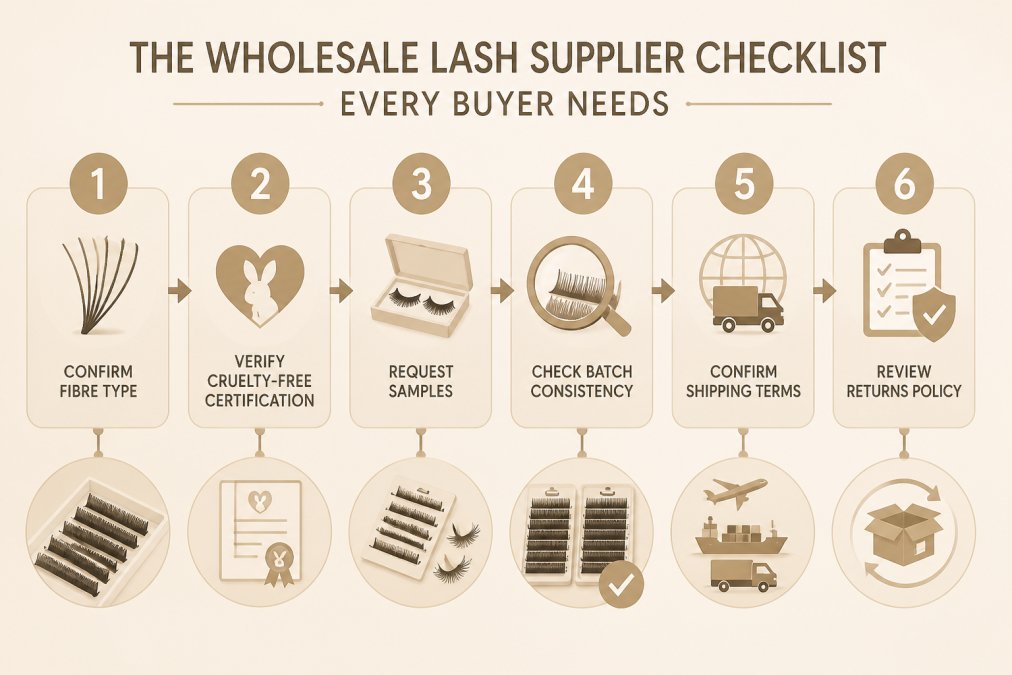
A common mistake is skipping the sample stage to save time. Samples cost a fraction of a bulk order and reveal more than any product page. Test curl retention, band flexibility and how the lash behaves after a full day's wear. If a supplier's sample disappoints, the batch will too.
Treat this checklist as a gate, not a formality. Suppliers who pass all six steps earn your repeat business. Suppliers who stumble on certification or returns aren't worth the risk, however attractive the headline price looks.
Building a Professional Makeup Artist Lash Kit
A professional makeup artist lash kit should cover the styles you actually reach for, not every lash on the market. Stock a core range: a natural everyday set, a wispy style for bridal work, and a fuller 3D or volume lash for evening looks. That trio handles most bookings.
Buy those three styles in bulk and keep a small selection of statement lashes for special requests. This keeps your kit lean and your spend focused where it earns its keep.
What most reviews miss is how much band flexibility affects application speed on set. A flexible band conforms to the eye in seconds, which matters when you're working through a bridal party. Rigid bands slow you down and need more glue to sit flat.
Pretty Lashes offers a 60% discount for makeup artists, which changes the bulk-buying maths considerably for working MUAs. Our pre-glued strip and cluster options also cut application time, and the flexible bands suit the range of eye shapes you'll meet on any given day.
Bulk Order Quantities, Shipping and Returns
Work out your bulk order quantities from real usage, not guesswork. Count how many sets you go through in a typical month, then order enough to cover two to three months. That buffer absorbs busy spells without tying up cash in stock that sits unused. Over-ordering is the most common bulk-buying mistake we see.
Shipping and returns deserve the same scrutiny as the product. Confirm lead times before you commit, especially if you're stocking up ahead of wedding season. Ask how faulty stock is handled and whether damaged sets are replaced or refunded. A clear returns policy protects you when a batch arrives below standard.
Pricing depends on quantity, style and delivery, so check our current prices on the website or request a quote for larger orders. Compare the total landed cost, including delivery, rather than the sticker price alone.
Storing Bulk Lashes So They Stay Salon-Ready
Store bulk lashes flat, in their trays, away from direct sunlight and damp. Heat warps the curl and humidity softens the band, and both ruin a set before it reaches a client. Keep stock in a cool, dry drawer or case, and never stack heavy items on top of lash trays.
Label batches by arrival date and rotate oldest stock to the front. First in, first out keeps your lashes at their best and stops you discovering a forgotten box months later.
For hygiene, keep a separate working set for client use and leave the bulk stock sealed until you need it. Handle lashes with clean tweezers rather than fingers. Small habits like these protect the investment you've made in a bulk order and keep every set looking as good as the day it arrived.
Conclusion
Bulk buying cruelty free lashes rewards the prepared buyer and punishes the impulsive one. Vet your supplier against the checklist, confirm both vegan and cruelty-free claims, and order to a realistic usage cycle. Do that and your cost per set drops while your quality stays consistent.
At Pretty Lashes, we've built our range around exactly this kind of buyer: sustainable, vegan and cruelty-free lashes with flexible bands and pre-glued options, plus a 60% discount for makeup artists. Our lashes are MUA-approved and designed to apply quickly and remove cleanly. Professional artistry relies on consistent standards, and integrating these high-quality lashes is a natural step toward establishing a complete cruelty-free makeup routine.
Ready to stock up? Shop All Lashes and build a kit your clients will notice.
Frequently Asked Questions
Where can I buy cruelty free lashes in bulk?
Specialist lash retailers and professional beauty suppliers are the most reliable route. Look for a supplier that states its fibre type, confirms vegan and cruelty-free status in writing, and offers tiered bulk pricing. Pretty Lashes sells cruelty free lashes in bulk with a 60% discount for makeup artists, plus pre-glued strips and cluster options. Order a sample set first so you can check band flexibility and curl before committing to larger quantities.
Are mink lashes cruelty-free?
Real mink lashes are not cruelty-free. The fur is collected from animals, and even brushed or shed harvesting involves keeping animals for their fur, which falls outside cruelty-free standards. If ethical sourcing matters to you, choose synthetic fibres such as PBT or plant-based alternatives. These match the look of mink, hold a curl well and are easier to clean between clients, which matters when you are buying in bulk.
What is the difference between vegan and cruelty-free lashes?
Cruelty-free means no animal testing took place at any stage of production. Vegan goes further and means no animal-derived ingredients or materials at all, so no mink, silk or horsehair. A lash can be cruelty-free but still contain animal fibres, so check both claims. For bulk buying, ask for written confirmation of each, because the two terms are often used loosely in product listings.
How can I check whether a lash supplier's ethical claims are credible?
Ask for documentation rather than trusting a badge on a product page. A credible supplier can name its manufacturer, confirm fibre composition and explain how it verifies no animal testing occurs. Look for recognised certification schemes and check that the claims cover the whole supply chain, not just the final assembly. Request samples so you can judge band quality and consistency, and ask how the supplier handles faulty batches.
