
Cruelty-Free Lash Adhesive for Sensitive Eyes: 2026 Guide
Table of Contents
- Why Sensitive Eyes Need a Different Lash Adhesive
- What Makes a Cruelty-Free Lash Adhesive Suitable for Sensitive Eyes
- Hypoallergenic Eyelash Glue: What the Label Really Means
- Vegan Lash Glue and Latex-Free Lash Glue: Why Both Matter
- Lash Glue Ingredients to Avoid If Your Eyes React
- How to Patch Test and Apply Lash Adhesive Without Irritation
- Conclusion: Choosing a Cruelty-Free Lash Adhesive for Sensitive Eyes
- Frequently Asked Questions
Last Updated: 14 October 2026
Why Sensitive Eyes Need a Different Lash Adhesive
If your eyes stream, itch or sting within minutes of applying strip lashes, you are not imagining it. A cruelty free lash adhesive for sensitive eyes is formulated to reduce the most common triggers, and it is the single change that stops most reactions.
The problem is rarely the lashes. It is what holds them on.
Standard adhesives rely on cyanoacrylate, the same family of chemicals used in industrial superglue. It cures fast and grips hard, which is exactly why it irritates delicate eyelid skin. Add latex, fragrance or preservatives and you have a recipe for redness, swelling and watery eyes.
Below, we explain what to look for on a label, which ingredients to avoid, and how to patch test properly before a full application.
What Makes a Cruelty-Free Lash Adhesive Suitable for Sensitive Eyes
A suitable adhesive for sensitive eyes is one that avoids known irritants, cures without harsh fumes, and carries no animal testing at any stage of production. Three things decide whether a glue will suit you:
- The base chemistry. Gentler formulas move away from aggressive cyanoacrylate concentrations.
- The additive list. Latex, formaldehyde and synthetic fragrance are the usual culprits behind reactions.
- The ethical claim. Cruelty-free means no animal testing; vegan means no animal-derived ingredients. They are not the same thing, and a product can be one without the other.
Reading a Lash Adhesive Label Before You Buy
Look for named ingredients, not marketing words. A reputable brand lists its full formula and states whether the product is latex-free, vegan and cruelty-free. If the packaging only says "gentle" with no ingredient list, treat that as a warning sign. Check the batch number and expiry date too, because adhesive degrades over time and older glue irritates more.
Hypoallergenic Eyelash Glue: What the Label Really Means
Hypoallergenic eyelash glue means the formula is designed to minimise allergic reactions, but the term is not regulated in the same way as a medical claim. It signals intent, not a guarantee.
That distinction matters. A glue labelled hypoallergenic can still contain an ingredient you personally react to. The label tells you the manufacturer has reduced common triggers; it cannot promise your skin will tolerate it.
This is why patch testing matters more than any claim on the box. According to NHS guidance on allergies, identifying a trigger through controlled exposure is the most reliable way to know how your body responds. We recommend testing every new adhesive, even one marketed squarely at sensitive eyes.
Vegan Lash Glue and Latex-Free Lash Glue: Why Both Matter
Vegan lash glue contains no animal-derived ingredients, while latex-free lash glue removes natural rubber from the formula. For sensitive eyes, the latex-free part usually matters more.
Natural rubber latex is a common allergen, and eyelid skin is thin enough to react quickly. If you have ever worn a plaster and found your skin red underneath, you may be sensitive to latex, and lash adhesive is a bad place to find out.
Vegan formulas matter for a different reason: they exclude ingredients such as beeswax, carmine and animal-derived glycerine. For anyone building a fully ethical kit, both labels need to be present. Pretty Lashes formulates its lash range as vegan and cruelty-free.
| Label claim | What it means | Why it matters for sensitive eyes |
|---|---|---|
| Cruelty-free | No animal testing at any stage | Ethical assurance, not a safety claim |
| Vegan | No animal-derived ingredients | Avoids carmine, beeswax, animal glycerine |
| Latex-free | No natural rubber latex | Removes a common contact allergen |
| Hypoallergenic | Formulated to reduce reactions | Lower risk, but no guarantee |
Lash Glue Ingredients to Avoid If Your Eyes React
Certain ingredients cause the majority of reactions, and learning to spot them takes two minutes. Check every new adhesive against this list before it goes near your eyes.
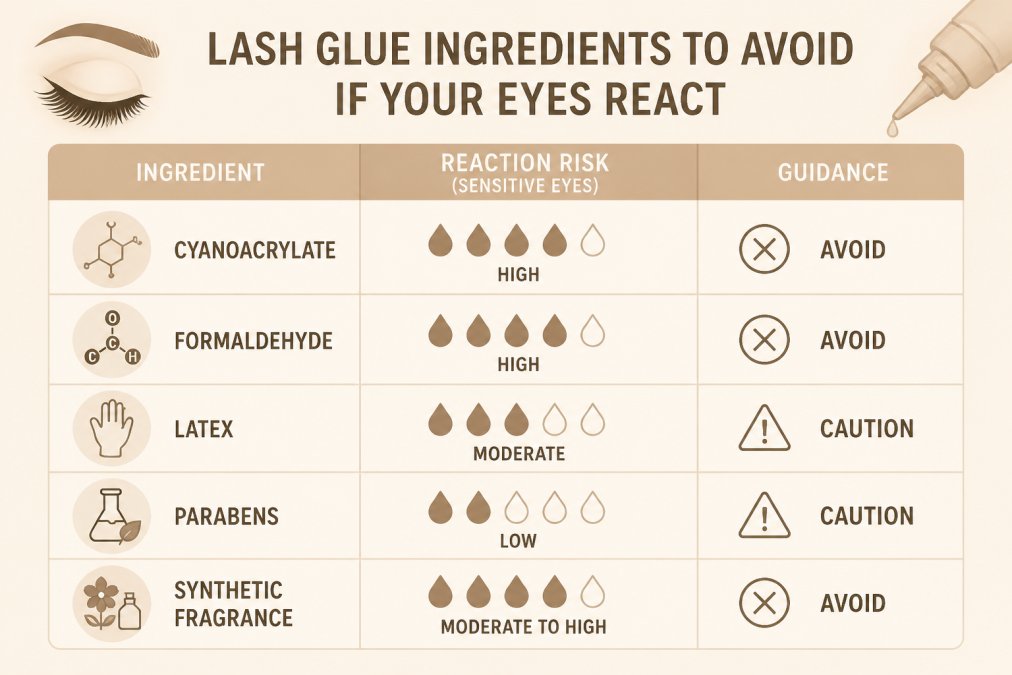
- Cyanoacrylate. The bonding agent in most adhesives. High concentrations cause stinging and fumes.
- Formaldehyde and formaldehyde releasers. Used as preservatives. A well-documented irritant.
- Latex. Natural rubber. A frequent cause of contact allergy.
- Parabens. Preservatives that some sensitive users react to.
- Synthetic fragrance. Added for scent. One of the most common cosmetic irritants.
The Cosmetic Ingredient Review publishes safety assessments on cosmetic ingredients, and it is a useful reference if you want to check a specific name.
How to Patch Test and Apply Lash Adhesive Without Irritation
A patch test takes 24 hours and prevents most reactions. Apply a small dot of adhesive to the inner forearm or behind the ear, wait a full day, and check for redness, itching or swelling. If the area reacts, do not use the product near your eyes.
When you are ready to apply, follow these steps:
- Cleanse the eyelids and let them dry completely.
- Apply a thin line of adhesive along the lash band and wait 30 seconds until tacky.
- Press the band to the natural lash line, starting from the outer corner.
- Hold for a few seconds, then check the inner corner is secure.
- Remove lashes at night by peeling gently from the outer edge, never pulling straight off.
As documented in NHS advice on eye health, persistent redness, swelling or pain around the eye should be assessed by a professional rather than treated at home.
Conclusion: Choosing a Cruelty-Free Lash Adhesive for Sensitive Eyes
Finding an adhesive that respects both your eyes and your ethics comes down to reading labels properly. Look for latex-free and fragrance-free formulas, check that cruelty-free and vegan claims are both stated, and always patch test first.
At Pretty Lashes, our lashes feature flexible bands and pre-glued options. Every style is vegan and cruelty-free, and our MUA-approved range is built for sensitive eyes and beginners alike.
Get started with Pretty Lashes and find a lash look that feels as good as it looks.
Frequently Asked Questions
What is the best cruelty-free lash adhesive for sensitive eyes?
There is no single best option, but the safest choices share three traits: a cruelty-free and vegan formula, no latex, and a short ingredient list without formaldehyde or heavy fragrance. Look for adhesives labelled hypoallergenic and check the full INCI list on the packaging rather than relying on front-of-pack claims. Patch test on your inner wrist or behind the ear for 24 hours before using any new adhesive near your eyes.
What ingredients should I avoid in lash adhesive if I have sensitive eyes?
The main ones to avoid are latex, formaldehyde and formaldehyde-releasing preservatives, parabens, and added fragrance or essential oils. Cyanoacrylate is the bonding agent in most adhesives and can irritate reactive eyes, so look for formulas that state they are low-odour or designed for sensitive wearers. If you have had a reaction before, keep the ingredient list from the old product and compare it against any new one.
Is vegan lash glue suitable for sensitive eyes?
Vegan means no animal-derived ingredients, which removes things like beeswax and carmine, but it does not automatically mean the formula is gentle. A vegan lash glue can still contain latex or fragrance that triggers irritation. Check that the product is both vegan and latex-free, and patch test before a full application. Vegan and cruelty-free labelling tells you about ethics, not about how your eyes will react.
How can I check whether a lash adhesive is genuinely cruelty-free?
Start with the brand's own statements and look for recognised cruelty-free certification logos, then check whether the parent company also tests on animals, as certification usually covers the brand rather than its owner. Be cautious with vague phrases like animal-friendly, which have no legal definition. If a brand cannot tell you who certifies it or where its ingredients come from, treat the claim as unverified until you have more detail.
